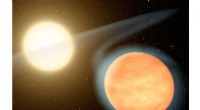
Black Holes:
* What they are: Regions of spacetime where gravity is so strong that nothing, not even light, can escape.
* How they form: From the collapse of massive stars at the end of their life cycle.
* Key features:
* Event horizon: The boundary around a black hole beyond which escape is impossible.
* Singularity: A point of infinite density at the center of a black hole.
* Accretion disk: A swirling disk of gas and dust that is drawn into the black hole.
* Effects:
* Warp spacetime and bend light.
* Can influence the movement of nearby stars and galaxies.
* Emit powerful radiation, such as X-rays.
White Holes:
* What they are: Hypothetical objects that are the opposite of black holes. They are thought to be the time-reversed versions of black holes, where matter and light can only escape, not enter.
* How they might form: Theories are not well-established, and their existence is still debated.
* Key features:
* No confirmed observations: No evidence of white holes has been found.
* Theoretical concept: They are based on the mathematical solutions of Einstein's equations of general relativity.
* Reverse flow of time: Matter and energy would be ejected from the white hole, flowing outwards.
Key Differences:
* Black holes are real: Their existence is confirmed by observations. White holes are theoretical.
* Black holes "suck" matter: Matter and energy fall into black holes. White holes "spew" matter out.
* Black holes have an event horizon: Nothing can escape a black hole once it crosses the event horizon. White holes are thought to have an "exit horizon", where matter can only escape.
Similarities:
* Both are predicted by general relativity.
* Both are related to singularities.
In summary: Black holes are proven, powerful celestial objects that trap matter. White holes remain a theoretical concept, potentially the "opposite" of black holes, where matter can only escape. While both are fascinating, our understanding of white holes is still limited.