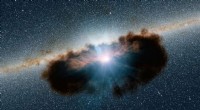
* Heterogeneous Composition: The Milky Way is made up of various distinct components, each with its own unique properties and distribution. These components include:
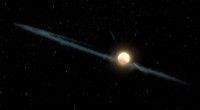
* Stars: Different types of stars (from massive blue giants to tiny red dwarfs) scattered throughout the galaxy.
* Gas and Dust: Interstellar clouds composed primarily of hydrogen and helium, along with trace elements. These clouds are unevenly distributed.
* Dark Matter: An enigmatic form of matter that makes up the majority of the galaxy's mass, but interacts with other matter only through gravity. Its distribution is also not uniform.
* Black Holes: Supermassive black holes at the galactic center and smaller black holes scattered throughout.
* Non-Uniform Distribution: These components are not evenly distributed. The galactic center is denser with stars and gas clouds than the outer regions. The spiral arms are rich in young stars and gas, while the space between arms is less dense.
Homogeneous Mixture vs. Heterogeneous Mixture:
* Homogeneous Mixture: A mixture where the components are evenly distributed and indistinguishable (e.g., salt dissolved in water).
* Heterogeneous Mixture: A mixture where the components are not evenly distributed and can be distinguished (e.g., sand and water).
Conclusion: The Milky Way's diverse components and uneven distribution make it a heterogeneous mixture rather than a homogeneous one.