Here's a breakdown of the main stages:
1. Protostar:
* A cloud of gas and dust (nebula) collapses under its own gravity.
* The core heats up and becomes denser.
* This stage lasts for a few million years.
2. Main Sequence:
* Nuclear fusion begins in the core, primarily fusing hydrogen into helium.
* This stage is the longest and most stable, lasting billions of years.
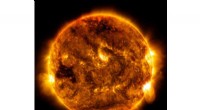
* The star is classified as a yellow dwarf during this stage, with a surface temperature around 5,500°C.
* Our Sun is currently in this stage.
3. Subgiant:
* The core runs out of hydrogen fuel.
* The core contracts, while the outer layers expand and cool.
* The star becomes a subgiant, increasing in size and luminosity.
4. Red Giant:
* Helium fusion begins in the core, leading to further expansion and cooling.
* The star becomes a red giant, with a surface temperature around 3,000°C.
* It's much larger than the main sequence stage, engulfing the orbits of inner planets.
5. Planetary Nebula:
* The outer layers are ejected as a planetary nebula.
* This nebula consists of gas and dust, illuminated by the hot core.
* The ejected material enriches the interstellar medium with heavier elements.
6. White Dwarf:
* The core remains as a white dwarf, a dense, hot, and small object.
* It slowly cools and fades over billions of years.
* White dwarfs are composed primarily of carbon and oxygen.
Important Notes:
* The duration of each stage depends on the star's initial mass.
* Stars with larger masses have shorter lifespans but reach higher temperatures and luminosities.
* The fate of a star depends on its mass.
* Our Sun will eventually become a white dwarf, but much larger stars might end their lives as supernovae.
In essence, the yellow dwarf star cycle describes the life and death of a star similar in size and mass to our Sun. It's a fascinating process that illuminates the evolution of stars and the universe as a whole.