1. Gravity:
* The sun's massive size and composition (mostly hydrogen and helium) create an incredibly strong gravitational pull.
* This pull acts on all objects within its gravitational influence, including the planets.
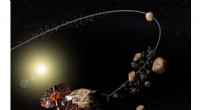
* The sun's gravity is the primary force that keeps the planets in their orbits.
2. Inertia:
* Planets are already moving due to their initial formation in the protoplanetary disk.
* This initial motion, combined with the sun's gravitational pull, results in a curved path—an orbit.
* Imagine a ball on a string being swung around. The string provides the centripetal force (similar to gravity) keeping the ball in a circular path. The ball's inertia (tendency to move in a straight line) keeps it from falling directly towards the center.
The balance between these two forces is what maintains a stable orbit:
* If gravity were stronger, the planet would spiral inward.
* If inertia were stronger, the planet would fly off into space.
It's important to note:
* Planets don't revolve in perfect circles, but rather in slightly elliptical paths. This is due to variations in their initial motion and gravitational influence from other planets.
* The speed of a planet's revolution changes depending on its distance from the sun. Planets move faster when closer to the sun and slower when farther away. This is due to the conservation of energy, with the planet trading potential energy (due to its distance from the sun) for kinetic energy (its motion).
So, it's the interplay of gravity and inertia that keeps the planets in their orbits around the sun.