Jupiter itself:
* Massive storms: Jupiter is known for its Great Red Spot, a gigantic storm that's been raging for centuries. Other storms are also common on the planet.
* Complex atmosphere: Jupiter's atmosphere is made up of mostly hydrogen and helium, but also contains traces of other elements. This creates bands of different colors and swirling patterns.
* Powerful magnetic field: Jupiter has a very strong magnetic field, which traps charged particles and creates an intense radiation belt.
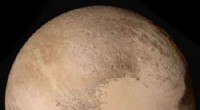
* Intriguing moons: Jupiter has 79 known moons, each with its own unique characteristics. Some, like Europa and Ganymede, are potentially habitable.
Jupiter's moons:
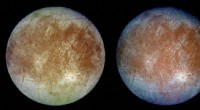
* Europa: This moon is covered in ice and may harbor a vast ocean beneath the surface. It's considered one of the most likely places in our solar system to find life.
* Ganymede: The largest moon in our solar system, Ganymede has its own magnetic field and possibly a subsurface ocean.
* Io: Io is the most volcanically active body in our solar system, with erupting volcanoes spewing sulfur and other materials.
* Callisto: This heavily cratered moon is thought to have a subsurface ocean and is one of the oldest objects in our solar system.
Findings from probes:
* Voyager 1 and 2: These spacecraft flew by Jupiter in the 1970s and provided the first close-up images of the planet and its moons.
* Galileo: This probe orbited Jupiter from 1995 to 2003, sending back detailed information about its atmosphere, moons, and magnetic field.
* Juno: This mission arrived at Jupiter in 2016 and is still orbiting the planet, studying its gravity field, magnetic field, and composition.
So, while we haven't found life on Jupiter or any of its moons yet, the ongoing exploration of this giant planet and its moons is revealing fascinating information about the evolution of our solar system and the potential for life elsewhere.