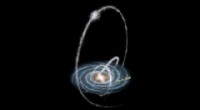
* Black holes are not the center of every galaxy: While supermassive black holes exist at the centers of most large galaxies, they're not the driving force behind the galaxy's formation or evolution. Galaxies are vast collections of stars, gas, dust, and dark matter held together by gravity, with the black hole playing a relatively minor role.
* Galaxies are not "storms" in the traditional sense: The term "storm" usually implies a chaotic and turbulent event with a defined beginning and end. Galaxies are stable structures that evolve over billions of years, with their dynamics dictated by gravity and the interactions of their constituents.
* Black holes are not "eyes" in the literal sense: Eyes are organs of sight, and black holes are regions of spacetime where gravity is so strong that nothing, not even light, can escape. They don't "see" or "observe" in any way.
Instead of an eye, think of the black hole as a powerful gravitational anchor:
* Gravitational influence: The supermassive black hole at the galaxy's center exerts a powerful gravitational pull on the surrounding material, influencing the movement of stars and gas within the galaxy.
* Active galactic nuclei (AGN): When material falls into a black hole, it releases vast amounts of energy, creating powerful jets and radiation that can influence the galaxy's evolution.
The analogy of a "storm" is more appropriate for describing the active galactic nuclei (AGN) associated with some supermassive black holes. These AGN are powerful sources of energy and radiation, creating "storms" of particles and radiation within the galaxy.
In summary, while black holes play a crucial role in galaxy dynamics, they are not the "eye" of a "storm" in the way we typically understand these terms. They are powerful gravitational anchors that influence the galaxy's evolution and can create dramatic events like AGN.