1. Studying Exoplanets:
- We've discovered thousands of planets orbiting stars outside our solar system (exoplanets).
- These discoveries give us insights into the diversity of planetary systems.
- We can deduce the size, mass, composition, and orbital characteristics of exoplanets.
2. Analyzing Star Systems:
- Observing the movement of stars and their gravitational interactions allows us to deduce the presence of unseen companions like planets or brown dwarfs.
- We can study the composition and age of stars to infer the likelihood of hosting planetary systems.
3. Simulating Galaxy Evolution:
- Using computer models, astronomers can simulate the formation and evolution of galaxies, including the development of solar systems within them.
- This allows us to explore different scenarios and understand the processes involved in creating planetary systems.
So, what do we know about other solar systems?
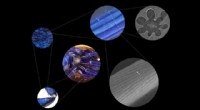
- Diversity: We've found that planets come in a wide range of sizes, compositions, and orbital configurations. There are "super-Earths," "mini-Neptunes," and "hot Jupiters," among many others.
- Multiple Planet Systems: It seems common for stars to host multiple planets, often in configurations different from our own solar system.
- Habitable Zones: Scientists are actively searching for exoplanets within the habitable zones of their stars, where liquid water could potentially exist on the surface.
What we still don't know:
- Direct Imaging: We haven't directly imaged a full planetary system outside our own. Current technology isn't advanced enough to capture detailed images of distant planets.
- Detailed Atmospheres: While we can detect some atmospheric components of exoplanets, we still lack the ability to thoroughly analyze their atmospheres and determine their potential for life.
The Future of Research:
With advancements in telescopes and space missions, we're continuously learning more about other solar systems.
- Missions like the James Webb Space Telescope will provide unprecedented views of exoplanet atmospheres.
- Future telescopes and space observatories will aim to directly image exoplanets and uncover their true nature.
As our knowledge grows, we'll gain a better understanding of the prevalence of solar systems like our own and the possibility of finding habitable planets beyond Earth.