1. Earth's Rotation:
* The Coriolis effect, caused by Earth's rotation, deflects moving air masses to the right in the Northern Hemisphere and to the left in the Southern Hemisphere.
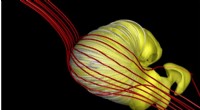
* This deflection creates large-scale circulation patterns called jet streams, which act like giant rivers of air flowing in the upper atmosphere.
2. Temperature Differences:
* The uneven heating of the Earth's surface by the sun creates temperature gradients, with warmer air near the equator and colder air near the poles.
* This difference in temperature creates pressure gradients, leading to air flowing from high-pressure areas to low-pressure areas.
* The Coriolis effect then interacts with these pressure gradients, shaping the flow of air into rotating systems.
3. Convection:
* Warm, moist air rises, cools, and condenses, forming clouds. This process, known as convection, is crucial for creating the vertical motion within storms and cloud systems.
4. Specific Features:
* Hurricanes are driven by warm, moist air converging at the center of a low-pressure system, rising, cooling, and releasing latent heat.
* Tornadoes form when strong thunderstorms create a rotating column of air that extends downward from the storm's base.
5. Other Factors:
* Topography: Mountains and other land features can influence wind patterns and create localized weather systems.
* Ocean currents: Ocean currents transport heat and moisture, influencing the atmosphere above.
In summary: The Earth's rotation, temperature differences, convection, and other factors create complex atmospheric conditions that drive the whirling clouds and storms we observe. These systems are not simply random occurrences but are governed by a complex interplay of physical forces.