Orbital Characteristics:
* Orbital Period: Planets further out have longer orbital periods (the time it takes to complete one orbit around the Sun). This is due to Kepler's Third Law, which states that the square of a planet's orbital period is proportional to the cube of its average distance from the Sun.
* Orbital Speed: Planets further out travel at slower orbital speeds. This is because they have less gravitational influence from the Sun, resulting in a slower orbital velocity.
* Orbital Shape: While most planets have nearly circular orbits, the further out a planet is, the more likely it is to have a more elliptical orbit. This is due to the weaker gravitational influence from the Sun, allowing for greater deviations in their paths.
Physical Characteristics:
* Temperature: Planets farther out are significantly colder. They receive less solar energy due to the inverse square law, which states that the intensity of light decreases as the square of the distance from the source.
* Composition: Outer planets tend to be composed of lighter elements like hydrogen and helium, forming gas giants like Jupiter and Saturn. These planets are also much larger than the inner rocky planets.
* Atmosphere: Outer planets have thicker atmospheres, often composed primarily of hydrogen and helium, and they often possess rings and numerous moons.
* Density: Outer planets are less dense than inner planets, due to their gaseous nature.
Other Differences:
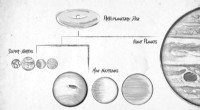
* Formation: The outer planets are thought to have formed in a colder region of the protoplanetary disk, where ices could condense and contribute to their growth.
* Magnetic Field: Some outer planets have stronger magnetic fields than inner planets, likely due to their rapid rotation and internal composition.
In Summary:
The planets farther from the Sun are colder, larger, less dense, have longer orbital periods, slower orbital speeds, and are primarily composed of gas. The inner planets are hotter, smaller, denser, have shorter orbital periods, faster orbital speeds, and are primarily composed of rock and metal. These differences are ultimately a result of the varying distances from the Sun and the conditions present during their formation.