Here's a breakdown of what makes up these arms:
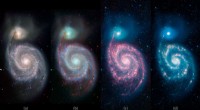
* Gas and Dust: The arms contain a higher concentration of gas and dust than the rest of the galactic disk. This material is the fuel for star formation.
* Young, Hot Stars: As the gas and dust condense under their own gravity, they form new stars, many of which are hot, massive, and blue. These stars are concentrated in the spiral arms, giving them their bright appearance.
* Star Clusters: The intense star formation in the arms often leads to the formation of clusters of young stars.
* Supernovae: The massive stars in the arms eventually explode as supernovae, creating shockwaves that can trigger further star formation.
How the Arms Form and Move:
* Density Waves: The spiral arms are not permanent structures but rather density waves that propagate through the galactic disk. They are areas of higher density, where matter is compressed as it moves through the wave.
* Gravitational Pull: The density waves are caused by gravitational interactions within the galaxy. The uneven distribution of mass in the galaxy, including the central bulge and the presence of other stars, can create gravitational forces that lead to the formation of these waves.
* Rotation: As the galaxy rotates, the density waves move through the disk, creating a spiral pattern. Stars and gas clouds are drawn into the arms as they pass through.
Why the Arms are Important:
* Star Formation: The arms are the primary locations of star formation within spiral galaxies. The higher concentration of gas and dust provides the necessary material for new stars to form.
* Galactic Evolution: The ongoing star formation in the arms influences the evolution of the galaxy over time.
* Spiral Galaxy Classification: The appearance and structure of spiral arms are used by astronomers to classify spiral galaxies into different types (e.g., barred spiral galaxies, flocculent spirals, grand design spirals).
So, the arms of a spiral galaxy are dynamic regions of intense activity, responsible for the galaxy's beauty and evolution.