* Black holes don't create stars. Stars are formed from clouds of gas and dust collapsing under their own gravity. Black holes, while incredibly massive, don't have the necessary materials or conditions to form stars.
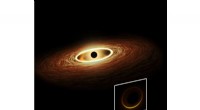
* Gravity can pull in nearby stars. A black hole's immense gravity can attract nearby stars, forming a cluster around it. This is called a "galactic nucleus" or "active galactic nucleus" if the black hole is actively feeding.
* Blue stars are massive and short-lived. While it's possible for some blue stars to be near a black hole, they are not inherently attracted to black holes. Blue stars are massive and burn through their fuel quickly, so they have shorter lifespans than other stars.
So, why might there be a perceived "bluge" of stars near a black hole?
* Optical illusions: The intense gravity of a black hole can bend light, creating optical illusions that can make nearby stars appear closer or more numerous than they actually are.
* Active galactic nuclei: Some galaxies have supermassive black holes at their centers that are actively feeding. This feeding process releases enormous amounts of energy, which can excite nearby gas and dust, leading to the formation of new stars. These stars may appear bluer due to their high temperatures.
It's important to remember that black holes are not inherently blue or surrounded by blue stars. The perception of a "bluge" can be due to optical illusions, the activity of the black hole, or other factors.