1. Angular Momentum:
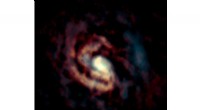
* Initial Conditions: When galaxies formed from the collapse of vast clouds of gas and dust, these clouds had inherent angular momentum. This means they were rotating.
* Conservation of Angular Momentum: As the cloud collapsed, its angular momentum had to be conserved. To conserve this momentum, the collapsing matter spun faster and flattened into a disk. Think of a figure skater pulling their arms in to spin faster; the same principle applies.
2. Gravity and Rotation:
* Centripetal Force: The rotation of the disk creates a centrifugal force that pushes matter outwards.
* Gravity's Pull: At the same time, gravity pulls matter inwards towards the center of the galaxy.
* Balance: These two forces balance each other, creating a stable disk shape.
3. Gas Dynamics:
* Collisions: In the early stages of galaxy formation, gas particles collided frequently. These collisions slowed down the gas in the radial direction (towards the center) while maintaining the angular momentum. This further contributed to the flattening of the disk.
* Cooling and Star Formation: The gas in the disk cools down, allowing it to collapse further and form stars. This star formation process happens more efficiently within the disk, further reinforcing its shape.
4. Bulges and Halos:
* Central Bulge: While the main body of a galaxy is disk-shaped, many galaxies have a central bulge which is more spherical. This bulge is likely formed by older stars that migrated towards the center of the galaxy.
* Halo: Galaxies also have a diffuse halo of stars and gas surrounding the disk. This halo is less dense and is often made up of older stars and gas that escaped from the disk.
In summary: The combination of angular momentum, gravitational forces, gas dynamics, and the presence of central bulges and halos contributes to the disk-shaped nature of most galaxies.
It's important to note that galaxies can have different shapes and sizes. Some galaxies are elliptical, others are irregular, and some even have multiple disks. However, the majority of spiral galaxies, like our Milky Way, are predominantly disk-shaped.