Size and Mass:
* Diameter: 4,880 km (3,032 miles)
* Mass: 3.30 × 10^23 kg (7.3 × 10^23 lbs)
* Density: 5.43 g/cm³ (slightly denser than Earth)
Composition:
* Surface: Primarily made of iron and nickel, with a thin silicate crust.
* Core: Extremely large iron core that takes up about 85% of the planet's radius. This gives Mercury its high density.
Atmosphere:
* Exosphere: Mercury has a very thin, almost nonexistent atmosphere called an exosphere. It's composed mainly of sodium, potassium, helium, and hydrogen.
Rotation and Orbit:
* Rotation period: 58.6 Earth days (a very slow rotation)
* Orbital period: 88 Earth days (the fastest orbital period of any planet in the solar system)
* Orbital eccentricity: Mercury's orbit is highly elliptical, causing large temperature variations between its perihelion (closest to the Sun) and aphelion (farthest from the Sun).
Surface Features:
* Craters: Covered with impact craters, evidence of a heavily bombarded past.
* Scarps: Long cliffs (some up to 2 km high) formed by the planet's contraction.
* Plains: Smooth plains likely created by ancient volcanic eruptions.
* Polar ice: There is evidence of water ice frozen in permanently shadowed craters at Mercury's poles.
Magnetic Field:
* Weak magnetic field: Mercury has a very weak magnetic field, about 1% of Earth's, which is still surprising given its large iron core.
Temperature:
* Surface temperature: Ranges from -173°C (-279°F) at night to 427°C (801°F) during the day, the most extreme temperature variation in the solar system.
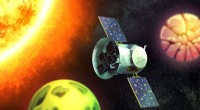
These are just a few of the many interesting physical properties of Mercury. It's a fascinating world that has been studied in detail by spacecraft like Mariner 10 and MESSENGER, and continues to be a subject of much scientific research.