1. Gravity:
* Initial Attraction: Gravity is the fundamental force that attracts particles towards each other. In a cloud of gas and dust, even a tiny imbalance in distribution can start a gravitational pull, attracting more particles to the denser region.
* Growing Attraction: As more particles clump together, the gravitational pull intensifies, further attracting more matter. This creates a positive feedback loop where the more mass accumulates, the stronger the gravity, and the more mass it attracts.
2. Random Motion and Collisions:
* Gas Pressure: The gas in the cloud is constantly moving and colliding, creating internal pressure that works against the gravitational collapse.
* Turbulence: The gas cloud might experience turbulence and eddies, which can both help and hinder the collapse process.
3. Cooling and Condensation:
* Heat Loss: As the cloud collapses, the particles collide more frequently, converting their kinetic energy into heat. This heat needs to be dissipated for the cloud to continue collapsing.
* Radiation: The cloud radiates heat into space, cooling the gas and allowing further contraction. This cooling is crucial, as it reduces the internal pressure, allowing gravity to dominate.
4. Rotation:
* Angular Momentum: The cloud is unlikely to be completely still. It might have some initial rotation. As the cloud collapses, its angular momentum is conserved, causing it to spin faster.
* Flattening: The spinning cloud flattens into a disk-like shape due to centrifugal force. This disk is the birthplace of planets.
5. Nuclear Fusion:
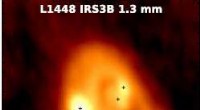
* Core Compression: As the cloud collapses, the core becomes extremely dense and hot.
* Fusion Ignition: When the core temperature and pressure reach critical levels, nuclear fusion begins, where hydrogen atoms fuse to form helium, releasing immense energy. This energy is what makes the star shine and balances the inward pull of gravity.
The Process in Summary:
1. Gravity pulls together gas and dust particles in a cloud.
2. The cloud cools as it radiates heat, allowing gravity to overcome internal pressure.
3. Rotation flattens the cloud into a disk.
4. The core heats up and compresses until nuclear fusion begins.
5. Fusion provides the energy that balances gravity, stabilizing the star.
It's a complex interplay of forces, and the details can vary depending on the initial conditions of the cloud, but this is the general picture of how stars are born.