1. The Presence of a White Dwarf:
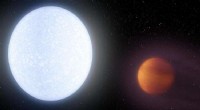
* The primary component must be a white dwarf, a dense, compact star remnant. White dwarfs are incredibly dense and have a strong gravitational pull.
2. A Companion Star:
* The white dwarf must have a close companion star, typically a main sequence star or a red giant.
3. Mass Transfer:
* The companion star must be close enough to the white dwarf that its outer layers are pulled towards the white dwarf due to its gravity. This process is called mass transfer.
4. Accretion onto the White Dwarf:
* The material pulled from the companion star accumulates on the white dwarf's surface, forming a layer of hydrogen-rich material. This process is known as accretion.
5. Thermonuclear Runaway:
* As the accreted hydrogen layer on the white dwarf becomes thicker and denser, the temperature and pressure inside the layer rise. Eventually, the temperature and pressure reach a point where nuclear fusion ignites explosively, causing a sudden burst of energy. This explosive fusion is called a thermonuclear runaway.
6. Nova Eruption:
* The thermonuclear runaway results in a massive explosion on the white dwarf's surface, throwing off a significant amount of material into space. This explosion is what we observe as a nova.
In summary, the key ingredients for a nova are a white dwarf, a companion star, mass transfer, accretion, and thermonuclear runaway.
Important Notes:
* Novae are not supernovae. While both are explosive events, novae are much less powerful and do not destroy the white dwarf.
* The white dwarf survives the nova and can experience multiple nova eruptions over time.
* The companion star may eventually be stripped of its outer layers by the white dwarf, leading to a different type of binary system.
Let me know if you'd like to know more about any specific aspect of this process!