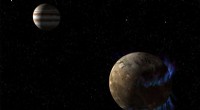
Here's what Galileo observed:
* They moved: The four objects were not stationary stars but seemed to orbit Jupiter. This challenged the prevailing geocentric view of the universe, where everything revolved around Earth.
* They were not stars: Galileo was able to distinguish the moons from stars because they were much closer to Jupiter and appeared to move relative to it.
* They were not just a trick of the telescope: Galileo observed the moons on multiple nights and confirmed their movement.
Galileo's observations of Jupiter's moons were a major contribution to the Copernican revolution and provided strong evidence for the heliocentric model, where the planets revolve around the sun.