* No Medium Needed: Unlike sound waves, which need a medium (like air or water) to travel, light waves are self-propagating. They consist of oscillating electric and magnetic fields that regenerate each other, allowing them to travel through a vacuum.
* Speed of Light: The speed of light in a vacuum is a fundamental constant, approximately 299,792,458 meters per second. This speed is determined by the properties of the electric and magnetic fields.
* Wave-Particle Duality: Light exhibits both wave-like and particle-like properties. While we often think of light as waves, it also behaves like tiny packets of energy called photons. These photons can travel vast distances through the vacuum of space.
How Light Travels:
1. Oscillating Fields: Light is created when an electric charge accelerates, producing oscillating electric and magnetic fields.
2. Self-Propagation: These fields interact and regenerate each other, propagating outward like ripples in a pond.
3. Vacuum Travel: This process can occur even in the vacuum of space, as the fields do not require a medium to travel.
Important Note:
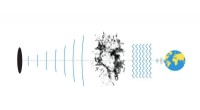
While light can travel through space, it is not always unimpeded. Things like dust, gas clouds, and gravitational fields can affect its path and intensity.