1. Spectroscopy:
* Absorption Lines: The most common method is spectroscopy. When starlight passes through the star's outer layers, atoms absorb specific wavelengths of light, creating dark absorption lines in the spectrum. Each element has a unique spectral signature (like a fingerprint), allowing astronomers to identify the elements present in the star.
* Emission Lines: Hot, ionized gases in the star's outer layers can also emit light at specific wavelengths, creating bright emission lines in the spectrum. These lines provide additional information about the composition and temperature of the star.
2. Analysis of Stellar Spectra:
* Line Strength: By measuring the strength (intensity) of absorption and emission lines, scientists can determine the abundance of each element in the star's atmosphere.
* Line Profiles: The shapes of spectral lines provide information about the star's temperature, pressure, and magnetic fields, which can further refine the composition analysis.
3. Other Methods:
* Stellar Models: Astronomers create computer models of stars to simulate their internal structure, evolution, and composition. These models are constantly refined based on observational data.
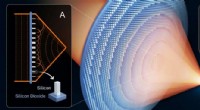
* Interferometry: Combining light from multiple telescopes allows scientists to create sharper images of stars, enabling the study of their surface features and compositions.
* Astroseismology: Studying the vibrations and pulsations of stars can reveal information about their internal structure and composition.
Example:
Let's say we observe a star and its spectrum shows strong absorption lines of hydrogen and helium, with weaker lines of calcium and sodium. This tells us that the star is primarily composed of hydrogen and helium, with smaller amounts of other elements.
Limitations:
* Surface vs. Internal Composition: Spectroscopy primarily reveals the composition of the star's outer layers (atmosphere). The internal composition can be different, particularly for massive stars.
* Evolutionary Changes: The composition of a star can change over its lifetime due to nuclear fusion and mass loss.
* Distance and Brightness: Studying faint and distant stars is challenging due to limited light and spectral resolution.
In summary, scientists use a combination of spectroscopy, stellar models, and other advanced techniques to determine the composition of stars, providing valuable insights into their formation, evolution, and the composition of the universe.