Effects of a Closer Orbit:
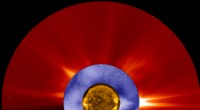
* Increased Temperature: As the planet gets closer to the sun, it receives more solar radiation. This will lead to a significant increase in surface temperature. The planet's atmosphere and any oceans could evaporate or even boil away.
* Faster Orbital Speed: Kepler's laws of planetary motion tell us that a planet's orbital speed increases as it gets closer to the sun. This means the planet would zip around the sun much faster.
* Stronger Tidal Forces: The gravitational pull of the sun gets stronger as the planet approaches. This will create stronger tidal forces, potentially leading to intense geological activity and even tidal heating.
* Changes in Seasons: If the planet has an axial tilt, a closer orbit could significantly alter its seasons. This would likely result in extreme temperature differences between the hemispheres.
* Potential for Life: The increased heat and radiation would likely make a planet closer to the sun uninhabitable for life as we know it. However, there might be unusual forms of life adapted to extreme conditions.
Causes of a Closer Orbit:
* Gravitational Interactions: A close encounter with another planet or a large asteroid could disrupt a planet's orbit and send it spiraling inward.
* Stellar Evolution: As the sun ages, it will expand into a red giant. This could draw planets closer to its surface.
Important Note: The scenario of a planet getting closer to the sun is a hypothetical one. While we have observed planets orbiting other stars, it's incredibly difficult to directly observe the long-term orbital evolution of a planet.
Beyond the Effects:
* This scenario is a great thought experiment that helps us understand the intricate interplay between gravity and planetary motion.
* Studying the effects of a closer orbit can provide insights into the potential habitability of exoplanets.
Let me know if you want to explore any of these points in more detail!