The nebular theory describes the formation of stars and planetary systems from giant clouds of gas and dust, called nebulae. Here's a breakdown of the process:
1. The Beginning: A Giant Molecular Cloud
* Vast and Cold: Nebulae are vast, cold, and composed mostly of hydrogen and helium, with small amounts of heavier elements.
* Gravity's Pull: Over time, gravity begins to pull particles within the nebula together.
* Rotation: As the cloud collapses, it starts to spin faster due to conservation of angular momentum. This spin creates a disk-shaped structure with a denser core.
2. Protostar Formation
* Core Formation: As the core of the nebula collapses, the gas and dust become more concentrated, creating a protostar.
* Nuclear Fusion: The protostar's core heats up due to gravitational pressure. When the core reaches a critical temperature and pressure, nuclear fusion ignites, releasing enormous amounts of energy and marking the birth of a star.
3. Protoplanetary Disk Formation
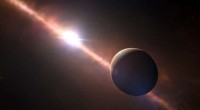
* Leftover Material: The remaining material around the newly formed star continues to swirl in a disk called a protoplanetary disk.
* Dust Grains: The disk contains dust grains that collide and stick together due to electrostatic forces. These grains act as seeds for future planets.
* Planetesimals: The dust grains grow into larger objects called planetesimals through accretion, where they gather more material through collisions.
4. Planet Formation
* Gravitational Dominance: Planetesimals continue to collide and merge, forming larger and larger bodies.
* Clearing the Disk: The most massive bodies in the protoplanetary disk dominate their gravitational zones, sweeping up remaining material and becoming planets.
* Differentiation: Planets develop distinct layers based on density, with heavier elements sinking to the core and lighter elements forming the outer layers.
5. Beyond Planet Formation
* Moons: Some planets attract smaller bodies to become their moons.
* Solar System Stability: Over time, the planetary system stabilizes, with planets orbiting the star in relatively predictable patterns.
* Continued Evolution: The planets, moons, and the star itself continue to evolve over billions of years.
Key Points to Remember:
* The nebular theory is widely accepted as the best explanation for the formation of our solar system and other planetary systems.
* The process involves a complex interplay of gravity, accretion, and the physics of matter at extreme temperatures and pressures.
* The formation of stars and planets is a continuous process happening across the universe.
This simplified explanation provides a general understanding of the nebular theory. There are still many details and variations in the process, and scientists continue to explore the nuances of star and planet formation.