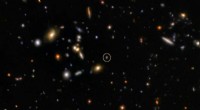
* The universe was static and unchanging. This was the prevailing view, based on the assumption that gravity would pull all the matter in the universe together.
* The Milky Way was the entire universe. They couldn't see beyond our own galaxy, and they assumed that everything they saw was part of it.
* Spiral nebulae were clouds of gas within the Milky Way. These mysterious objects were thought to be vast clouds of gas and dust, perhaps sites of star formation.
However, this view was challenged by a groundbreaking discovery made by Edwin Hubble in the 1920s. He used the newly constructed Mount Wilson Observatory telescope to study Cepheid variable stars in the Andromeda nebula.
Hubble's observations showed that:
* The Andromeda nebula was much farther away than previously thought. It was actually a separate galaxy, much like our own.
* Andromeda was moving away from us. He observed a redshift in its light, which is a sign that the object is moving away.
Hubble's work revolutionized our understanding of the universe. It showed that the universe is much larger than we thought, and that it is expanding. This led to the development of the Big Bang theory, which is now the prevailing model of the universe.