Here's what we can see based on observations and simulations:
* Accretion Disk: Gas and dust drawn into the black hole form a swirling disk around it. This disk heats up due to friction, emitting intense light and radiation across the electromagnetic spectrum.
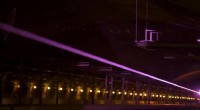
* Jet: Some black holes emit powerful jets of particles that travel at near-light speeds. These jets are often observed as bright, narrow beams of light.
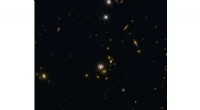
* Gravitational lensing: The immense gravity of a black hole bends light around it, causing a distortion of background objects. This can create multiple images of distant galaxies or stars.
* Event Horizon: The boundary around a black hole beyond which nothing, not even light, can escape. This is the point of no return and cannot be directly observed.
In summary:
A black hole itself is invisible, but we can observe its influence through:
* Bright, swirling accretion disks
* Powerful jets of particles
* Distortions of light due to gravitational lensing
While we can't directly "see" a black hole, the data we collect provides compelling evidence for their existence and allows us to study their properties.