Here's a breakdown of the reasons why Mars might have fewer small craters compared to Earth:
* Atmospheric Erosion: Mars has a thin atmosphere, but it's still enough to cause some erosion of smaller craters over time. This is especially true for craters less than a few meters wide.
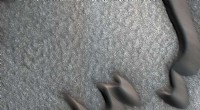
* Dust Storms: The frequent and massive dust storms on Mars can further contribute to the erosion and obliteration of smaller impact features.
* Geological Activity: While less active than Earth, Mars still experiences geological activity like volcanic eruptions and tectonic shifts. These events can resurface the planet, burying or erasing smaller craters.
* Impacting Objects: The size and frequency of impacting objects can also play a role. Mars is further away from the asteroid belt and has a weaker gravitational pull, meaning fewer smaller objects hit its surface.
* Limited Observation: It's important to remember that our observations of Mars are still limited. It's possible that smaller craters exist but have not been detected due to the resolution of our instruments.
In conclusion: Mars has a combination of factors that contribute to a lower density of small impact craters compared to Earth. However, it's not completely devoid of them. Furthermore, the research on Martian craters is ongoing and continues to provide new insights into its geological history.