* Quasars are not galaxies: They are extremely luminous and energetic objects powered by supermassive black holes at the center of galaxies. They represent a phase in a galaxy's life, not a separate evolutionary stage.
* Spiral galaxies are diverse: Spiral galaxies themselves come in many forms, from small, faint galaxies to massive, luminous giants. They have different histories, masses, and stellar populations.
* Evolutionary paths vary: Galaxies evolve through mergers, star formation, and other processes. Their evolution is influenced by their environment and initial conditions.
So, what's the relationship between quasars and spiral galaxies?
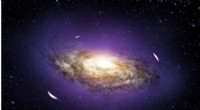
* Quasars can be found in the centers of some galaxies: These galaxies may be spiral, elliptical, or other types.
* Quasar activity is a phase: It typically occurs when a galaxy is young and actively forming stars. The supermassive black hole at the center feeds off the gas and dust, creating the intense luminosity of a quasar.
* Quasars eventually fade: As the galaxy ages, the black hole runs out of fuel, and the quasar activity subsides. The galaxy then settles into a more "normal" state, like a spiral galaxy.
Instead of a "gap", think of it as a spectrum:
* Young, active galaxies: May have a powerful quasar in their center.
* Mature galaxies: May have a less active or inactive supermassive black hole, but still have the same basic structure (e.g., spiral).
In summary: The evolution of galaxies is complex and multifaceted. There isn't a clear-cut "gap" between quasars and spiral galaxies. Instead, it's more accurate to think of them as different phases within a galaxy's lifetime, with many possible evolutionary paths.