If you enjoy science fiction, then you know that the thought of colonizing the moon makes for some incredibly imaginative stories. But there is a good possibility that lunar cities will become a reality during the 21st century! Colonizing Mars is another option as well.
Right now, one of the biggest problems with the idea of a moon colony is the question of building supplies. There is no Home Depot on the moon, so the building supplies have to come from somewhere. The only place to get the supplies right now is the Earth, with the space shuttle acting as a truck. Using the space shuttle in this way is something like using FedEx to get all of the materials for building a house to a construction site -- It's incredibly expensive and not very efficient!
Asteroids may be a much better place to get the supplies. Early evidence suggests that there are trillions of dollars' worth of minerals and metals buried in asteroids that come close to the Earth. Asteroids are so close that many scientists think an asteroid mining mission is easily feasible. Several international organizations are developing plans for going up to get these natural space resources.
In this edition of How Stuff Will Work, we'll examine what valuable resources miners could find on asteroids and discuss how a space mining operation could get those resources out!
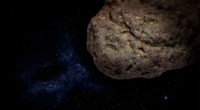
 The main-belt asteroid Ida is a metal-rich S-type that could be mined for space colony supplies.
Photo courtesy NASA
The main-belt asteroid Ida is a metal-rich S-type that could be mined for space colony supplies.
Photo courtesy NASA
Scientists think asteroids are leftover material from the early formation of the solar system or debris from the destruction of a planet. There are tens of thousands of asteroids circling the sun. Most are grouped inside the asteroid belt, between the orbits of Mars and Jupiter. Some asteroids that stray from this orbit, though, flying close to Earth on occasion -- you've probably heard about the possibility of these asteroids smashing into Earth in the future, as in the movie "Armageddon."
Most asteroids fit into three basic categories:
Even without a manned mission to do a full-scale study of an asteroid, scientists know a lot about what asteroids contain. Astronomers use telescopic spectroscopy, which analyzes light reflected from the asteroid's surface, to find out what might be there. In addition to iron, nickel and magnesium, scientists think water, oxygen, gold and platinum also exist on some asteroids.
Water interests space explorers most because it could help keep a space colony alive. Without water, there is really no way to move forward with human exploration of space. Water could also be broken down into hydrogen and oxygen to form rocket engine propellant. The metal ore on the asteroids could be mined and used for building spacecraft and other structures for a space colony.
Corporations that might not be interested in exploring space for the adventure and science could be interested in the treasures that a space mining operation could send back to Earth. One NASA report estimates that the mineral wealth of the asteroids in the asteroid belt might exceed $100 billion for each of the six billion people on Earth. John S. Lewis, author of the space mining book Mining the Sky, has said that an asteroid with a diameter of one kilometer would have a mass of about two billion tons. There are perhaps one million asteroids of this size in the solar system. One of these asteroids, according to Lewis, would contain 30 million tons of nickel, 1.5 million tons of metal cobalt and 7,500 tons of platinum. The platinum alone would have a value of more than $150 billion!
Asteroids have amazing potential for industry. But what will it take to land on an asteroid, find these valuable materials, extract them and process them? In the next section, you will find out how asteroid mining operations might supply the Earth and its colonies on other planets with a plenitude of materials.
The drive to set up a mining operation on an asteroid is a matter of simple economics. While building an asteroid mine will cost billions of dollars, it will be far cheaper than carrying supplies from Earth to the moon or Mars.
Spacecraft would have to carry food and supplies for the mining crew and the equipment for the mine. Newly developed spacecraft should make landing on an asteroid possible. After all, we have already landed on the moon, and some asteroids pass by closer than the moon. A spacecraft going to an asteroid would need less rocket power and fuel than one going to the moon.
One problem will be how to keep the asteroid from rotating while it's being mined. Some experts suggest attaching rockets to the asteroid to take the spin out of it. But once miners land on the asteroid, just how do they plan to dig on it, process the materials extracted and transport it to a space colony or to Earth?
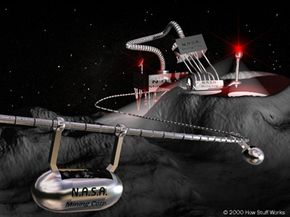
No one knows for sure what the first asteroid mine will look like, but here are some good assumptions:
Because of the lack of gravity and atmosphere, ferrying the newly mined materials to the moon will be easy. Once there, they can be refined and formed into structures!