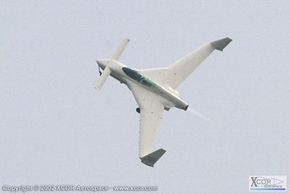
Going to space is expensive -- about $10,000 per pound, in fact. So until recently, only governments could afford to go into space. But in 2004, the commercial spacecraft SpaceShipOne made two sub-orbital flights into outer space, winning the $10 million Ansari X Prize. SpaceShipOne dropped from an airplane between about 46,000 to 48,000 feet, ignited its rocket engine, traveled to 150,000 feet, re-entered the Earth's atmosphere and glided to a landing. But can a commercial spacecraft take off on its own from the ground, travel into outer space and land again on a runway? That's the goal of XCOR Aerospace, and it starts with the EZ-Rocket.
In this article, we'll learn about the technology behind the EZ-Rocket and see how XCOR plans to expand on this technology in the future.
The EZ-Rocket is the first privately built and flown rocket plane, and serves as the test bed for new technologies. XCOR Aerospace designed the EZ-Rocket, which they modified from Bert Rutan's Long-EZ airplane. The Long-EZ is a homebuilt aircraft kit manufactured by Rutan's Aircraft Factory. It is a fixed-wing canard aircraft, which means that its tailplane is ahead of its wings instead of behind them. This gives the plane good gliding characteristics, making it ideal for a rocket plane.
 A Rutan Long-EZ 160 with its tailplane ahead of the pilot
Public domain photo by Adrian Pingstone
A Rutan Long-EZ 160 with its tailplane ahead of the pilot
Public domain photo by Adrian PingstoneThe EZ-Rocket's modifications included the following:
 EZ-Rocket main components
Photo courtesy XCOR Aerospace
EZ-Rocket main components
Photo courtesy XCOR AerospaceRutan added the external fuel tank because the original Long-EZ tanks were not designed to hold alcohol or withstand high pressure. He added the oxygen tanks because rocket engines must carry their own supply of oxygen (airplane engines get their oxygen from the atmosphere).
 EZ-Rocket engines and oxygen tanks
Photo courtesy XCOR Aerospace
EZ-Rocket engines and oxygen tanks
Photo courtesy XCOR AerospaceEach rocket engine on the EZ-Rocket produces 400 pounds of thrust, or force (each Space Shuttle Main Engine, or SSME, produces about 375,000 pounds of thrust). Rocket engines do not need to produce the huge amounts of force that the space shuttle does because they do not have to lift as much mass as the space shuttle does. Like the space shuttle's engines, EZ-Rocket's engines are regeneratively cooled. This means that the cold liquid fuel is pumped around the combustion chambers to remove excess heat and keep them from melting. The EZ-Rocket carries enough fuel for only 3.5 minutes of rocket burn time.
We'll look at exactly how the EZ-Rocket works next.
The Fuel and OxidizerThe choice of liquid oxygen and alcohol (or LOX/alcohol) as the oxidizer and fuel for the EZ-Rocket has several advantages. It has a specific impulse of 250 to 270 seconds (specific impulse is the units of thrust per the units of propellant consumed over time). In contrast, the shuttle's liquid hydrogen/liquid oxygen combination has a specific impulse of 453 seconds. The longer the impulse time, the more efficient the fuel and the faster the rocket can go. In addition, this type of engine does not need extensive cryogenic cooling for both fuel and oxidizer. This makes storing and refueling the EZ-Rocket faster and efficient.
 The EZ-Rocket on takeoff
Photo courtesy XCOR Aerospace
The EZ-Rocket on takeoff
Photo courtesy XCOR AerospaceWhen the pilot (usually Bert Rutan's brother, Dick) starts up the EZ-Rocket, alcohol flows under pressure from the fuel tank into the rocket engine. A piston pump pumps the liquid oxygen into the engine. XCOR had to design a unique pump because turbopumps used in other rocket engines are too large. Then an electrical igniter sparks the fuel and oxidizer. Combustion begins. and the hot gases leave the rocket nozzle out the back, generating the thrust. With both engines running (generating 800 pounds of thrust), it takes 20 seconds and 1650 feet (500 meters) of runway to take off.
The EZ-Rocket takes off, flies, and lands like a conventional airplane, with some exceptions:
In one test, the pilot performed a a touch-and-go maneuver -- he touched down on the runway without power, rolled several hundred feet, re-ignited the rocket engine and took off again. The EZ-Rocket has successfully performed 15 flights and a number of tests, including touch-and-go maneuvers and an in-flight abort maneuver. It has also demonstrated its abilities at air shows, including the 2005 X-Cup Rocket Racing Exposition in New Mexico.
 A test-fire of the EZ-Rocket's LOX/alcohol engine. The series of rings in the plume are shock diamonds, or Mach disks, which occur when the exhaust plume's pressure is lower than atmospheric pressure.
Photo courtesy XCOR Aerospace
A test-fire of the EZ-Rocket's LOX/alcohol engine. The series of rings in the plume are shock diamonds, or Mach disks, which occur when the exhaust plume's pressure is lower than atmospheric pressure.
Photo courtesy XCOR AerospaceWhile the EZ-Rocket was built onto the Long-EZ airframe, it was never intended for personal use -- only as a test bed for new technologies. But like any aircraft or spacecraft, there must be safety features built in to meet the most frequent emergency needs such as a fire in the engine or engine failure. The EZ-Rocket has an ultraviolet fire sensor in the engine bay wired to the instrument panel, which alerts the pilot to any fire in the engine. Two large bottles of pressurized helium in the bay are used as fire extinguishers when the pilot throws a switch on the instrument panel. Each engine has its own control systems and can be turned on and off independently (the EZ-Rocket can climb on one engine). Each engine also has a blast shield made of Kevlar and a burn-through sensor that signals the pilot when the fuel is gone.
If necessary, the pilot can depressurize both fuel tanks and vent the alcohol and/or the liquid oxygen into the atmosphere. He can also shut off fuel to both engines if there is a fire or one engine fails to shut down. The main valves and igniter are linked to prevent gases from collecting in the combustion chamber and igniting inadvertently, and the propellant valves are linked together to coordinate valve timing. The canopy can open quickly and the pilot has a parachute in the event he has to exit the EZ-Rocket.
XCOR successfully tested many of these safety features in the in-flight abort maneuver. Now the company is building on the success of the EZ-Rocket with two new projects. We'll learn about these in the next section.
 A poster for Leading Edge Rocket Racing, the first Rocket Racing League team
Image courtesy Rocket Racing League
A poster for Leading Edge Rocket Racing, the first Rocket Racing League team
Image courtesy Rocket Racing LeagueThe EZ-Rocket has made its last flights testing new rocket plane technologies. XCOR Aerospace is now moving on to two new projects: the development of rocket racers and a suborbital spacecraft.
Dr. Peter Diamandis, founder of the Ansari X-Prize, has established the Rocket Racing League (RRL) with Granger Whitelaw, a two-time Indianapolis 500 champion. Diamandis and Whitelaw envision wide television coverage and large audience turnouts like those of NASCAR. The Rocket Racers will race worldwide in independent events, on a 5000-feet high, two-mile long track. Fans will watch the planes fly through a virtual course created by Sportvision (the same company that created the "1st and 10" line on football fields). The season will culminate in a championship race for a $2 million purse at the X Prize Cup, an annual event held in Las Cruces, New Mexico.
The Rocket Racing League will spark the development of new technologies from private companies and inspire new generations of rocket scientists. Rocket racing test demonstrations were performed at the 2005 X-Prize Cup. In January 2006, the Rocket Racing League announced a contest for fans to name the first Mark-1 X-Racer. The prize includes e a one-year VIP pass to all Rocket Racing League events. The winner will be announced in October 2006, when the Mark-1 X-Racer is revealed to the public for the first time.
 Artist's rendering of a Rocket Racing League venue
Image courtesy Rocket Racing League
Artist's rendering of a Rocket Racing League venue
Image courtesy Rocket Racing League The Mark-1 X-Racer Development Vehicle
Photo courtesy Rocket Racing League
The Mark-1 X-Racer Development Vehicle
Photo courtesy Rocket Racing LeagueXCOR Aerospace's next project is the creation of a suborbital space plane, Xerus. They have identified three markets that could benefit from an inexpensive, reusable launch vehicle:
 Artist's rendering of the Xerus
Image courtesy XCOR Aerospace
Artist's rendering of the Xerus
Image courtesy XCOR AerospaceXerus will use several main engines to reach an altitude of 100 miles (about 65 km), then coast to 130 miles (about 100 km). It will reach a top speed of Mach 4, about 10 times faster than the EZ-Rocket, and will take off and land like a conventional airplane. Once outside the atmosphere, the craft will use 50-lb rocket thrusters for maneuvering (attitude controls). Xerus will use liquid-fueled rocket technology like that developed and tested on EZ-Rocket. It will also use piston pumps for both the fuel and the oxidizer (EZ-Rocket only uses one for the oxidizer). XCOR is developing this technology for NASA and the Defense Department.
 Artist's rendering of the Xerus launching a small payload
Photo courtesy XCOR Aerospace
Artist's rendering of the Xerus launching a small payload
Photo courtesy XCOR AerospaceOnce XCOR finishes the design for Xerus, it plans a program of 20 test flights.
For lots more information on the EZ-Rocket, the Rocket Racing League, Xerus and related topics, check out the links on the next page.
Past Rocket PlanesThe Germans developed rocket planes -- the Lippisch Ente and the Messerschmitt Me 163 Bs and Cs -- along with jet engines during World War II. These planes reached speeds of 600 miles per hour (966 km/h), just under the speed of sound. The Soviet Union also experimented with rocket planes, and the Japanese even developed a rocket-powered Kamikaze bomber.
After World War II, rocket planes were used experimentally to test the performance of aircraft at hypersonic speeds. On Oct. 14, 1947, Chuck Yeager was the first to break the sound barrier in the Bell X-1 rocket plane.
Perhaps the most famous rocket plane was NASA's X-15. The X-15 was built to research the aerodynamics, stability, flight controls, heating, and physiological effects of high-speed, high-altitude flight. It made 199 flights between June 1959 and October 1968 and set altitude (354,200 feet, or 67 miles) and speed (4520 mph, or Mach 6.7) records for piloted, hypersonic flight. Information from the program was useful in developing the Mercury, Gemini, Apollo and Space Shuttle programs.
Read MoreSources
Thanks to Charles Scott Williams for his assistance with this article.