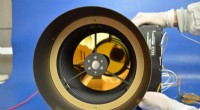
1. Spectroscopy: This involves analyzing the light emitted or absorbed by celestial objects. Different elements and molecules emit or absorb light at specific wavelengths, creating unique "fingerprints" that can be used to identify the composition of stars, planets, and interstellar gas clouds.
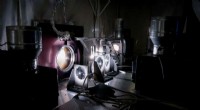
2. Laboratory Simulation: Chemists can recreate the extreme conditions found in space within controlled laboratory environments. This allows them to study the chemical reactions that might occur in stars, nebulae, or the atmospheres of planets, helping to understand the formation and evolution of celestial objects.
These are just two examples, and chemists use many other techniques like isotopic analysis, modeling, and collaborating with other scientists in fields like astronomy and physics to contribute to our understanding of the universe.