The Basics:
* High Temperatures and Pressures: Fusion requires incredibly high temperatures (millions of degrees Celsius) and immense pressure. These conditions are found in the cores of stars.
* Hydrogen Fuel: The most common fusion reaction in stars involves isotopes of hydrogen, primarily deuterium and tritium.
* Energy Release: When these nuclei fuse, they form helium, and a small amount of mass is converted into a huge amount of energy according to Einstein's famous equation E=mc².
The Stellar Fusion Process:
1. Proton-Proton Chain: The most common fusion reaction in stars like our Sun is the proton-proton chain. This involves a series of steps where hydrogen nuclei (protons) fuse to form helium.
2. Carbon Cycle: In heavier stars, the carbon cycle is more prevalent. This involves carbon as a catalyst for fusion reactions, eventually leading to the production of helium and heavier elements.
Importance in Astronomy:
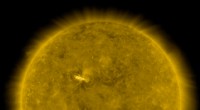
* Stellar Energy: Nuclear fusion is the fundamental source of energy that makes stars shine. It's responsible for the light, heat, and radiation that we observe from stars.
* Element Creation: Fusion creates heavier elements from lighter ones. This is how stars "manufacture" the elements that make up planets, life, and the universe itself.
* Stellar Evolution: The types of fusion reactions that occur in a star determine its evolution, lifespan, and eventual fate (becoming a red giant, white dwarf, neutron star, or black hole).
* Supernovae: In massive stars, the fusion process continues to create heavier elements until iron is formed. Iron cannot fuse to release energy, leading to a gravitational collapse and a powerful supernova explosion. Supernovae are the source of the heaviest elements in the universe.
Beyond Stars:
Nuclear fusion is also believed to occur in other celestial objects like:
* Red Giants: Larger stars expand into red giants, where fusion continues in shells around the core.
* Neutron Stars: These incredibly dense objects are formed from supernovae and may exhibit fusion reactions on their surfaces.
* Active Galactic Nuclei (AGN): Supermassive black holes at the centers of galaxies can accrete matter and generate extreme heat, potentially triggering fusion.
Harnessing Fusion on Earth:
Scientists are trying to harness nuclear fusion on Earth to provide a clean and sustainable energy source. While the technology is still under development, fusion has the potential to be a revolutionary energy source.
In summary, nuclear fusion is the driving force behind the evolution and energy output of stars, playing a crucial role in creating the elements and shaping the universe as we know it.