When you watch a space shuttle launch or see old video clips of the Apollomoon landings, you may dream of flying into outer space. In the past, that privilege has been reserved for highly trained astronauts and a few high-paying passengers. But the dream could become a reality for more people as a new space liner called Virgin Galactic sets up shop. You'll just need to scrape up about $100,000 first. True, that's not cheap, but it's a whole lot better than the $25 million that other space tourists have paid.
Virgin Galactic is the brainchild of British billionaire Sir Richard Branson. He has partnered with Burt Rutan, the designer of Ansari X Prize-winner SpaceShipOne, to build a fleet of spacecraft that will carry paying passengers into outer space and back.
Virgin Galactic has licensed the designs and technologies of SpaceShipOne to create two new ships, SpaceShipTwo and WhiteKnightTwo (the turbo jet that carries SpaceShipTwo into the air). The ships were unveiled in January 2008, but passengers have been signing up since 2005. And sometime around 2010, they'll finally be launching into space.
SpaceShipTwo takes passengers on a wild two-and-a-half-hour flight, blasting them 360,000 feet (109,728 meters) above the Earth and giving them a four- to five-minute zero-gravity experience (and, as an added bonus, passengers officially become astronauts by traveling more than 50 miles (80 kilometers) into space). After the brief suborbital flight, the spacecraft re-enters the atmosphere and glides back to Earth.
Both Rutan and Branson believe that the success of their designs has opened the door to space tourism, that tourist flights can be done safely and that the space tourism industry will be successful. So, how do these new spaceships work, exactly? How safe are they? And how do you score a spot on a Virgin Galactic flight?
Video Gallery: Space TourismPer Wimmer is going to be one of the first Virgin Galactic passengers in 2009. See how space tourism will work in this video from Reuters.
Three astronauts -- a cosmonaut, a former Microsoft executive and a NASA astronaut -- returned to Earth safely after several months in the International Space Station in 2007. The executive, Charles Simonyi, paid $25 million for his space odyssey
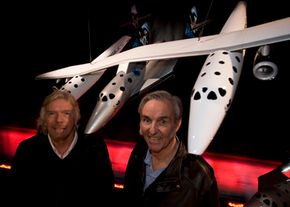
Read More Contents Sir Richard Branson with a model of WhiteKnightTwo and SpaceShipTwo
Photo courtesy Virgin Galactic
Sir Richard Branson with a model of WhiteKnightTwo and SpaceShipTwo
Photo courtesy Virgin GalacticOn June 21, 2004, pilot Mike Melville flew SpaceShipOne (SS1) on the first private manned spaceflight. On Sept. 27, 2004, Sir Richard Branson and Burt Rutan announced plans to build the first commercial spacecraft. Within a week, Melville and another pilot flew SS1 on the qualifying flights for the Ansari X Prize. Rutan and his company, Scaled Composites, won the X Prize and set the stage for Virgin Galactic.
Virgin Galactic has signed contracts with Scaled Composites to design and build SpaceShipTwo (SS2) and WhiteKnightTwo (WK2). It has also joined up with Paul Allen's Mojave Aerospace Ventures to license SS1's technology (Allen was co-founder of Microsoft, and his company owns and funded the development of SS1), and the state of New Mexico to build a spaceport hub for Virgin Galactic.
Virgin Galactic began operations in 2005, setting to work on a fleet of five SS2s and two WK2s -- the company plans to invest up to $250 million to develop the space tourism industry. In December 2005, Virgin Galactic announced that it had its first 100 passengers, and by early 2008 it had received more than $31 million in deposits from prospective passengers.
Although Virgin Galactic had originally planned to test the spacecraft in early 2008 and begin commercial flights in 2009, an accident at Scaled Composites in July 2007 disrupted this schedule. In the nonfiring test of the flow of oxidizer in the rocket engine, an explosion killed three technicians and injured three other workers [source: USA Today].
Despite the incident, Virgin Galactic unveiled its plans for SS2 and WK2 in January 2008 and intends to order five more spacecraft. Commercial operations are planned for sometime after 2010, starting with one flight per week and building up to one or two flights a day. The company hopes to turn a profit within five years after flights begin. The operations of Virgin Galactic will fall under regulation of the FAA and the New Mexico Space Authority.
Sir Richard BransonRichard Branson was born in England in 1950. He attended the Stowe School and established a national magazine called Student at age 16. His entrepreneurship continued when he started a mail-order record company and shop in London when he was 20. At 22, he opened a recording studio and signed his first artist. His Virgin Records company continued throughout the 1980 and was sold to Thorn EMI in 1992 for $1 billion.
While operating Virgin Records, Branson started a transatlantic airline, Virgin Atlantic Airways, which flew from London to New York, Los Angeles, Tokyo, and several other cities. Branson heads the Virgin Group of companies, which includes airline, train, book and software companies -- he had a net worth of $3.8 billion in 2007 [source: Forbes.com].
Besides being a self-made billionaire and managing his companies, Branson is an adventurer. In 1986, he set a record for a transatlantic crossing in his boat, the Virgin Atlantic Challenger II. In 1987, he flew the first hot air balloon across the Atlantic Ocean. He flew a balloon across the Pacific Ocean from Japan to Canada to set another record in 1991.
Read More The WhiteKnightTwo takes off just like a regular jet and releases SpaceShipTwo (which is attached in the middle) when it reaches 50,000 feet.
Photo courtesy Virgin Galactic
The WhiteKnightTwo takes off just like a regular jet and releases SpaceShipTwo (which is attached in the middle) when it reaches 50,000 feet.
Photo courtesy Virgin GalacticVirgin Galactic will use technologies developed and tested on SS1 in its designs for WK2 and SS2.
Like WhiteKnightOne, WK2 is made of carbon composites -- it's the world's largest all carbon-composite aircraft. It's powered by four Pratt and Whitney PW308A turbo jet engines and has two crew compartments on either side of the point where SS2 attaches to its underside. WK2 can lift and launch SS2 as well as other payloads, such as small unmanned rockets capable of carrying small satellites into low Earth orbit. WK2 will also serve as a training vehicle for the SS2 astronauts and pilots, training them for weightlessness by flying parabolic flight paths (see How Zero-gravity Flights Work and How Weightlessness Works). The WK2 aircraft is near completion and expected to begin flight tests in summer 2008.
SS2 is 60 feet (18.3 meters) long (more than twice the length of SpaceShipOne) and 7.5 feet (2.3 m) wide. It has a wing span of 27 feet (8.2 m), a tail height of 15 feet (4.6 m) and can carry two pilots and six passengers. The passenger cabin is 12 feet (3.7 m) long and 7.5 feet (2.3 m) wide. Virgin Galactic compares SS2 to a Gulfstream business jet.
The SS2 features:
 SpaceShipTwo in flight
Photo courtesy Virgin GalacticSpaceport America
SpaceShipTwo in flight
Photo courtesy Virgin GalacticSpaceport AmericaThe first test and commercial flights of WK2 and SS2 will leave from Mojave Air & Space Port in California. Virgin Galactic has contracted with the state of New Mexico to build its headquarters, in Upham, N.M. It will cost approximately $200 million [source: Virgin Galactic].
The spaceport will be constructed into the landscape so as to be heated and cooled efficiently. It will be powered by solar panels and have environmentally friendly heating, cooling and ventilation systems. will consist of three zones:
 A view of the Earth from SpaceShipOne
Photo courtesy Virgin Galactic
A view of the Earth from SpaceShipOne
Photo courtesy Virgin GalacticThe flight plan for Virgin Galactic's WK2/SS2 flights calls for a suborbital flight. A suborbital flight has a parabolic flight path -- like the shape that's made when you throw a rock into the air and it falls back down. The spacecraft won't fly fast enough to go into low Earth orbit as the space shuttle does (meaning it won't travel around the globe). The flights will be somewhat like the early Mercury flights of Alan Shepard and Virgil I. Grissom, but will last longer.
WK2 will take off from the ground like any jet aircraft -- but with SS2 attached to the underside. When it gets to an altitude of 50,000 feet, it will release SS2. When the SS2 pilots ignite the hybrid rocket motor, SS2 will accelerate vertically to Mach 3 in about 90 seconds (the crew and passengers will experience 3 to 4 Gs during this time) and climb to more than 300,000 feet (91,440 meters). After the engine is shut off, the wings will be feathered in preparation for re-entry (see previous page). During this time, SS2 will be at its highest point -- about 360,000 feet (109,728 m) -- and the crew and passengers will experience weightlessness.
Then the passengers return to their seats and recline for re-entry. During re-entry, the passengers will pull about 6 Gs. SS2 will feather until it falls to an altitude of 70,000 feet, when the pilots reconfigure the wings from feather mode to glider mode, and SS2 will glide to a landing back at the spaceport. The total flight time will have been two and a half hours. Upon return, the passengers will celebrate and receive their astronaut wings.
In the United States, people who fly more than 50 miles (264,000 feet) above the Earth are designated as astronauts (the Fédération Aéronautique Internationale considers those who fly above 62 miles (327,000 feet) to be astronauts). Virgin Galactic will award passengers astronaut wings after their flight, and the Federal Aviation Administration may give them astronaut badges as well.
Mach NumbersIn physics, velocity is expressed in terms of meters per second. In aerodynamics, velocity is often expressed relative to the speed of sound (1,100 ft/s or 343 m/s). The unit is called the Mach number after physicist Ernst Mach. An aircraft traveling at the speed of sound moves at Mach 1. An aircraft flying at twice the speed of sound is moving at Mach 2. So, the Mach number is a multiple of the speed of sound.
 Sir Richard Branson gives a thumbs-up during the unveiling of a scale model of SpaceShipTwo in 2006.
Don Emmert/AFP/Getty Images
Sir Richard Branson gives a thumbs-up during the unveiling of a scale model of SpaceShipTwo in 2006.
Don Emmert/AFP/Getty ImagesVirgin Galactic started booking passengers in 2005. Anyone who can pay the fee and pass a physical can go on a flight. Prospective passengers can book their flights directly through the Virgin Galactic Web site or through authorized ticket agencies across the globe. The costs are as follows:
Obviously, these flights cost significantly less than the $20 million that space tourists Dennis Tito (2001) and Mark Shuttleworth (2002) paid to fly aboard a Russian Soyuz spacecraft to the International Space Station.
Prospective passengers have to go through three days of training and pass a physical exam before their flight. As of January 2008, about 80 people had started training, which includes spinning in a centrifuge at 3 to 4 Gs. Further training will involve zero-gravity flights aboard WK2 to get acquainted with the weightlessness experience. When full operations start up, this training will take place at Spaceport America.
Virgin Galactic has emphasized safety in the designs of WK2 and SS2. For example, the hybrid rocket engine doesn't require storage of explosive propellants. The air launch of SS2 doesn't expose passengers to the risks associated with rocket launches -- if the rocket fails to ignite, SS2 can glide back for a safe landing. Feathering is a safer way to re-enter the atmosphere without incurring high heat loads like the space shuttle does. (But SS2 doesn't reach the velocity that the space shuttle does).
Virgin Galactic is the first company out of the gate, but others are vying to get into the burgeoning space tourism industry.
To learn more about Virgin Galactic and space tourism, take a look at the links on the next page.
G-forcesAcceleration is the rate of change of velocity. When your car is going from zero to 60 mph in 30 seconds, you're accelerating. In physics, acceleration is measured in meters per second squared. However, because we're familiar with that we experience due to Earth's gravity (g = 9.8 m/s2), acceleration is sometimes expressed in terms of Gs (1 G = 9.8 m/s2, 2 Gs = 19.6 m/s2, 3 Gs = 29.4 m/s2, etc.). According to Newton's second law of motion, acceleration is directly proportional to the force experienced divided by the mass of an object -- so, Gs are also associated with the force that a given mass experienced during acceleration. For example, when you start, corner or brake a typical car, you experience anywhere from 0.3 to 1 G. A roller coaster may accelerate you to 3 or 4 Gs for brief periods. Fighter pilots can experience as much as 8 Gs.
Accelerations affect the human body in various ways depending on the g-force and the length of time that you are exposed to those forces. At 2 Gs, your body will feel heavy (actually, because weight is equal to mass times acceleration (g), at 2 Gs you'll feel twice your body weight). At G forces above 4, people black out as it becomes harder for the heart to pump blood to the brain. To counteract this, spacecraft designs place astronauts in sitting positions in the direction of motion to distribute the g-forces equally across the body and limit the acceleration of the spacecraft, if possible. Fighter pilots wear special pressure suits that inflate and squeeze the abdomen to force blood to the pilot's head. Extreme accelerations (more than 15 Gs) can be fatal.
Read More