Imagine an eclipse. The sky darkens, and a black disc moves across the face of the sun. For a few minutes, everything around you gets eerie like a midday twilight, and then as daylight slowly returns, the experience fades into memory. Well done! You've pictured a total solar eclipse as viewed from the path of the totality, where the moon has completely blocked the light of the sun.
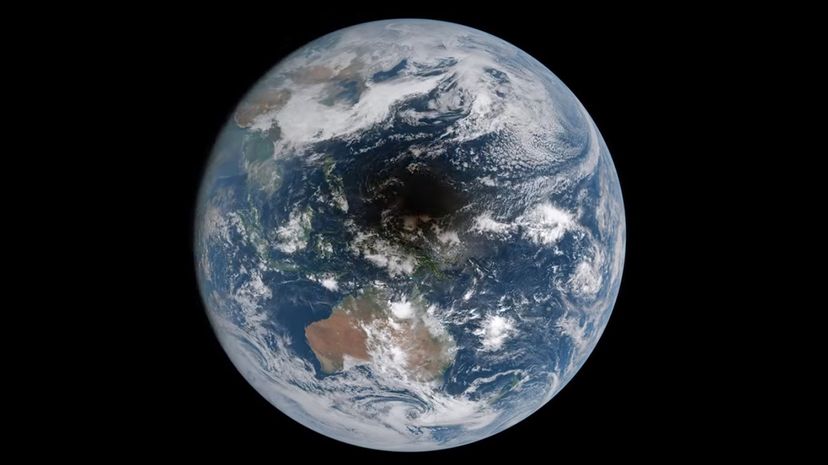
But what does the captivating phenomenon look like from far away? Like, from really far away — and looking not at the sun, but right back at Earth? What does a total solar eclipse look like from space?
 A solar eclipse occurs when the moon passes between Earth and the sun. Learn how the moon blocks the sun's light to Earth during an eclipse.
HowStuffWorks
A solar eclipse occurs when the moon passes between Earth and the sun. Learn how the moon blocks the sun's light to Earth during an eclipse.
HowStuffWorks
Japan's Himawari-8 satellite is in geostationary orbit above the Pacific Ocean, meaning it travels at a constant orbital speed relative to Earth's rotation, maintaining a location above a single spot on the planet. This video shows the satellite's capture of the total solar eclipse that crossed over parts of Indonesia, Micronesia and the Marshall Islands on March 9, 2016. Watch for the dark spot that travels from the bottom left of the screen in the video above to the upper right — that's the moon's shadow, and anyone in that path would've experienced the totality of the eclipse.
What's the bright white circle that seems to travel in opposition to the moon's shadow, traversing the equator from east to west? That's a phenomenon known as a sun glint, which happens when a planet's atmosphere and surface reflects the sun's light. Here's a Martian sun glint in a NASA image from June 8, 1998.
Unless something truly miraculous happens within the next few weeks, commercial space tourism is unlikely to make a trip to space possible by the Aug. 21, 2017, total solar eclipse — so this video will have to do for now. But if you're in the United States at that time, here's everything you need to know about where, when and how to observe the phenomenon.
Now That's InterestingEarth usually experiences two solar eclipses per calendar year, but up to five can take place. That's extremely uncommon, though, occurring only in 0.5 percent of eclipses in the last five millennia, according to NASA. 1935 was the last time Earth experienced five eclipses in one year, and calculations show it won't happen again until 2206.