Understanding the Concepts
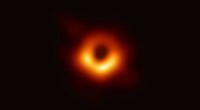
* Schwarzschild Radius: The radius of the event horizon of a black hole, the point beyond which nothing, not even light, can escape.
* Event Horizon: The boundary of a black hole.
* Mass and Density: A black hole's size is entirely determined by its mass. The more massive an object, the larger its Schwarzschild radius.
The Calculation
1. Earth's Mass: The Earth has a mass of approximately 5.972 × 10^24 kilograms.
2. Schwarzschild Radius Formula: The formula for the Schwarzschild radius is:
```
Rs = 2GM / c^2
```
Where:
* Rs is the Schwarzschild radius
* G is the gravitational constant (6.674 × 10^-11 m^3 kg^-1 s^-2)
* M is the mass of the object (in this case, Earth's mass)
* c is the speed of light (299,792,458 m/s)
3. Plugging in the Values:
```
Rs = 2 * (6.674 × 10^-11 m^3 kg^-1 s^-2) * (5.972 × 10^24 kg) / (299,792,458 m/s)^2
```
4. Solving for Rs:
```
Rs ≈ 0.00887 meters
```
Conclusion
If the Earth were to collapse into a black hole, its Schwarzschild radius would be approximately 8.87 millimeters (a little less than a third of an inch). This means the black hole would be incredibly dense and small, fitting within the size of a dime!
Important Note: The Earth would need to be compressed to an incredibly high density for this to happen. This kind of collapse is not realistically possible under normal conditions.