1. Increasing Pressure and Density:
* The pressure increases dramatically with depth, reaching hundreds of times Earth's atmospheric pressure at the cloud tops.
* The density of the gases also increases, transitioning from a gas to a fluid state.
2. Temperature Changes:
* The temperature initially decreases with depth, reaching a minimum around 100 km below the cloud tops.
* However, below this point, the temperature starts to increase due to internal heat sources.
3. Compositional Changes:
* Upper Atmosphere: The upper atmosphere is dominated by hydrogen (H2) and helium (He), with traces of methane (CH4), ammonia (NH3), and water (H2O).
* Mid-Atmosphere: As you descend, the temperature and pressure increase, leading to the formation of clouds composed of the aforementioned compounds.
* Deep Atmosphere: At deeper levels, the pressure and temperature become so high that the hydrogen and helium are no longer in their gaseous state. They transition into a metallic liquid, forming a metallic hydrogen layer.
4. Metallic Hydrogen:
* This unique phase of hydrogen behaves like a liquid metal, conducting electricity and generating Jupiter's powerful magnetic field.
* The core of Jupiter is likely composed of a dense mixture of rock and ice, surrounded by this metallic hydrogen layer.
5. Formation of Icy and Rocky Materials:
* Under the immense pressure and heat, the heavier elements like oxygen, carbon, and nitrogen combine with hydrogen to form compounds like water (H2O), methane (CH4), and ammonia (NH3).
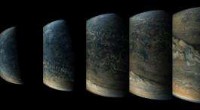
* These compounds condense and form clouds at different altitudes, creating the banded appearance of Jupiter.
In summary:
Jupiter's atmosphere undergoes significant changes with increasing depth, characterized by:
* Increasing pressure and density, transitioning from gas to fluid.
* Initial decrease in temperature, followed by an increase due to internal heat.
* Shifting composition, with hydrogen and helium transitioning to a metallic liquid state.
* Formation of clouds composed of icy and rocky materials at different altitudes.
These transformations create a complex and dynamic atmosphere, contributing to Jupiter's unique characteristics.