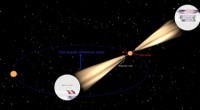
1. Changes in Earth's Orbital Eccentricity: Earth's orbit around the sun is not perfectly circular, but slightly elliptical. This eccentricity varies over long periods (tens of thousands of years).
* When eccentricity increases: Earth's orbit becomes more elongated. This means there's a greater difference between the closest point to the sun (perihelion) and the farthest point (aphelion). This leads to stronger seasonal contrasts, with warmer summers and colder winters.
* When eccentricity decreases: Earth's orbit becomes more circular. Seasonal contrasts lessen, leading to more moderate temperatures throughout the year.
2. Changes in Earth's Axial Tilt (Obliquity): Earth's axis is tilted at approximately 23.5 degrees. This tilt is responsible for the seasons.
* When axial tilt increases: Summers become hotter and winters become colder. This is because the hemispheres are tilted more directly towards or away from the sun during their respective summers and winters.
* When axial tilt decreases: Seasons become less pronounced, with milder summers and winters.
3. Precession of the Equinoxes: Earth's axis of rotation also wobbles like a spinning top, completing a full wobble every 26,000 years. This wobble affects the timing of the solstices and equinoxes.
* Shifting Solstices/Equinoxes: As precession happens, the dates of solstices and equinoxes slowly drift. This changes the amount of sunlight received at different times of the year, influencing the length and intensity of seasons.
Important Note: These changes in Earth's movement are very slow and happen over extremely long timescales. They are considered a key driver of long-term climate cycles, such as the glacial-interglacial periods that have shaped Earth's history. However, it's crucial to remember that these astronomical factors are just one piece of the complex puzzle of climate change. Human activity, particularly the release of greenhouse gasses, is now the dominant factor driving rapid and unprecedented changes in Earth's climate.