* Stars: The fundamental building blocks. They are giant balls of hot gas that generate light and heat through nuclear fusion. Our Sun is a star.
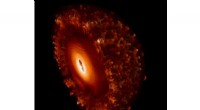
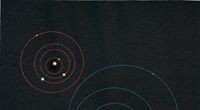
* Solar Systems: A system consisting of a star and all the objects gravitationally bound to it. This includes planets, moons, asteroids, comets, and dust. Our solar system revolves around our Sun.
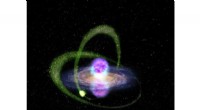
* Galaxies: Massive collections of stars, gas, dust, and dark matter held together by gravity. They can contain billions or even trillions of stars. Our solar system is located within the Milky Way galaxy.
Think of it like this:
* Imagine a single grain of sand – that's a star.
* Now imagine a handful of sand – that's a solar system with its star and all its objects.
* Finally, picture a vast beach with countless grains of sand – that's a galaxy, with billions of stars and their solar systems.
Key points:
* Stars form solar systems: The gravity of a star pulls in the surrounding material, which eventually coalesces into planets, moons, and other objects.
* Solar systems form galaxies: Galaxies are vast collections of stars and their solar systems, all bound together by gravity.
* Our solar system is just one tiny part of a much larger galaxy: The Milky Way is just one of billions of galaxies in the observable universe.
Let me know if you'd like to learn more about any of these concepts!