Here are some possibilities for what could come after the solar system, depending on the context:
Focusing on size and scale:
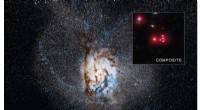
* Galaxy (Milky Way): Our solar system is located within the Milky Way Galaxy, a massive collection of stars, planets, gas, and dust.
* Local Group: The Milky Way is part of a group of galaxies called the Local Group.
* Supercluster (Virgo Supercluster): The Local Group is part of a larger structure called the Virgo Supercluster.
* Observable Universe: This is the portion of the universe that we can observe from Earth.
Focusing on celestial objects:
* Stars: The Sun is a star, and there are billions of other stars in the galaxy.
* Interstellar Medium: The space between stars is not empty, but filled with gas and dust.
* Nebulae: These are giant clouds of gas and dust where stars are born.
* Black Holes: These are regions of spacetime where gravity is so strong that nothing, not even light, can escape.
Focusing on space exploration:
* Interstellar Travel: This is the idea of traveling between stars, which is currently beyond our technological capabilities.
* Exoplanets: Planets that orbit stars outside of our solar system.
Focusing on scientific concepts:
* Gravity: The force that holds the solar system together.
* Electromagnetism: The force that governs light and other forms of radiation.
* Dark Matter and Dark Energy: These are mysterious substances that seem to make up most of the universe's mass and energy.
To give you a more specific answer, please tell me:
* What is the purpose of your concept map?
* What are you trying to show with it?
* What are the other branches of your concept map?
Once you provide more context, I can help you choose the best things to place after the solar system.