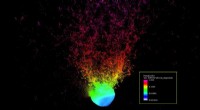
Immediate Aftermath:
* Starbursts: The gravitational forces involved in the collision trigger a burst of star formation, creating vast numbers of new stars in a relatively short period. This is due to the compression of gas and dust clouds, leading to intense star formation.
* Tidal Disruption: The gravitational pull of the colliding galaxies can rip apart star systems and gas clouds, creating long, trailing streams of material called tidal tails.
* Supernovae: The intense star formation also leads to an increase in supernovae, as massive stars quickly burn through their fuel and explode.
Long-Term Effects:
* Merger: The galaxies will eventually merge into a single, larger galaxy. This process can take billions of years.
* Black Hole Interaction: The supermassive black holes at the center of each galaxy will interact with each other, potentially merging to form a single, even more massive black hole.
* Evolution of the Galaxy: The new galaxy will likely be a more chaotic and unstable entity for a time, but will eventually settle into a new equilibrium. This new galaxy will be a different type of galaxy than either of the originals.
* Formation of New Stars: Continued star formation may occur in the merged galaxy, depending on the amount of gas and dust present.
Important Notes:
* Collisions aren't head-on: Most galaxy collisions are not head-on. The galaxies usually pass through each other, interacting over a long period.
* Stars rarely collide: Despite the vast number of stars, the distances between them are so immense that individual stars rarely collide during a galactic merger.
* Our Milky Way: The Milky Way galaxy is on course to collide with the Andromeda Galaxy in about 4 billion years. This event will reshape our local cosmic neighborhood.
The aftermath of a galaxy collision is a spectacular and complex phenomenon. It paints a picture of cosmic evolution and the ever-changing nature of the universe.