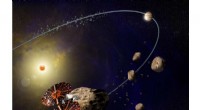
* Natural Satellites (Moons): These are celestial bodies that naturally orbit a planet due to its gravitational pull. They are formed through various processes, including:
* Capture: A small celestial body gets pulled into orbit by a planet's gravity.
* Co-formation: A moon forms at the same time as the planet from the same disk of material.
* Collision: A large impact on a planet creates debris that eventually coalesces into a moon.
* Artificial Satellites: These are human-made objects that orbit a planet. They serve various purposes, such as communication, navigation, weather monitoring, and scientific research.
Here are some notable examples of natural satellites:
* Earth's Moon: Our only natural satellite, it plays a significant role in Earth's tides and stability.
* Jupiter's Moons: Jupiter has a vast system of 79 confirmed moons, the largest being Ganymede, Callisto, Io, and Europa.
* Saturn's Rings: While not technically a single moon, Saturn's rings are made up of countless icy particles and smaller moonlets.
* Mars' Moons: Mars has two small moons, Phobos and Deimos.
Interesting Facts:
* Not all planets have moons. For example, Venus and Mercury do not have any natural satellites.
* Some moons have atmospheres, while others are airless.
* Some moons exhibit geological activity, including volcanoes and tectonic plates.
* The largest moon in our solar system is Ganymede, which is even bigger than the planet Mercury.
To learn more about specific satellites, you can search online for information about individual planets and their moons. Websites like NASA and the European Space Agency are excellent resources.