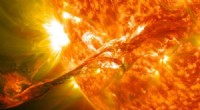
1. The Formation of a Black Hole:
* This is the event where a massive star collapses under its own gravity, creating a singularity with such strong gravitational pull that even light cannot escape. This is a very energetic and violent event, often accompanied by a powerful explosion called a supernova.
2. An Event Horizon Telescope Observation:
* In April 2019, the Event Horizon Telescope (EHT) captured the first ever image of a black hole's shadow, specifically the supermassive black hole at the center of the galaxy M87. This was a major scientific breakthrough, providing visual evidence of the existence of black holes and furthering our understanding of these mysterious objects.
3. A Gravitational Wave Event:
* When two black holes merge, they release a massive amount of energy in the form of gravitational waves, which can be detected by instruments like LIGO and Virgo. These events provide valuable information about the properties of black holes and the nature of gravity.
4. A General Term for Anything Related to Black Holes:
* In some contexts, "black hole event" might be used as a catch-all term for any event related to black holes, such as the detection of Hawking radiation, the study of black hole accretion disks, or even the theoretical possibility of black hole evaporation.
To understand what "black hole event" refers to in a specific context, you need more information. For example, you might need to know:
* The source of the information: Was it a news article, a scientific paper, or a conversation?
* The context of the discussion: Was it about astronomy, astrophysics, or some other field?
* Any additional details provided: Were there specific dates, locations, or types of observations mentioned?
By providing more context, you can ensure that you understand the correct meaning of "black hole event" in the given situation.