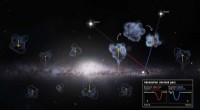
* The Milky Way is huge: Our galaxy is massive, spanning tens of thousands of light-years across. The halo, a diffuse region of gas and dark matter surrounding the galactic disk, extends even further. To get a truly "outside" view, a spacecraft would need to travel incredibly far, likely millions of light-years away.
* Current technology limitations: While we have sent probes beyond our solar system, reaching distances far beyond the Milky Way's halo is currently technologically infeasible. The distances and the time required for such a mission are beyond our current capabilities.
* Alternative approaches: To study the Milky Way's structure and its halo, scientists rely on other methods:
* Observations from Earth: Powerful telescopes on Earth allow us to map the Milky Way's structure in detail, including its halo.
* Space telescopes: Telescopes like the Hubble Space Telescope, although not designed specifically for this purpose, can provide valuable insights into the galaxy's structure by observing distant stars and galaxies.
* Simulations: Computer models and simulations help scientists understand the evolution and dynamics of the Milky Way's halo and its interactions with other galaxies.
The Bottom Line:
While it's a fascinating idea, photographing the Milky Way from beyond its halo is not something NASA or any other space agency is currently planning. The technological challenges and the vast distances involved make this extremely difficult. However, scientists continue to develop new technologies and approaches to study our galaxy in greater detail.