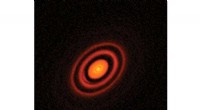
1. The Protoplanetary Disk:
* Composition: The initial cloud of gas and dust that gave rise to the solar system contained a mix of elements, but the composition varied depending on the distance from the newly forming Sun. Lighter elements like hydrogen and helium were more abundant in the outer regions, while heavier elements like iron and silicon were more concentrated closer to the Sun.
* Temperature: The inner region of the disk was much hotter than the outer region due to the Sun's heat. This heat played a significant role in what materials could condense into solids.
2. Condensation and Accretion:
* Inner Planets: In the hot inner region, only the heavier elements like iron, nickel, and silicates could condense into solid particles. These particles then collided and accreted to form the rocky inner planets: Mercury, Venus, Earth, and Mars.
* Outer Planets: In the colder outer region, lighter elements like hydrogen, helium, methane, and ammonia could also condense. These materials, along with ices, formed the cores of the giant gas planets: Jupiter, Saturn, Uranus, and Neptune.
3. The Role of Gravity:
* Gas Giant Formation: The large, icy cores of the outer planets had enough gravitational pull to attract and hold onto vast amounts of gas from the surrounding disk, ultimately forming the gas giants.
* Planetary Migration: The gravitational interactions between the planets and the protoplanetary disk could cause them to migrate, shifting their positions within the solar system.
4. Other Factors:
* Solar Wind: The Sun's early solar wind, a powerful stream of charged particles, blew away much of the lighter material from the inner region, further contributing to the differences in composition.
* Asteroids and Comets: The leftover material from the solar system's formation is now found in the asteroid belt between Mars and Jupiter, and in the outer reaches of the solar system as comets. These objects provide clues to the early composition of the solar system.
In Summary:
The differences between the inner and outer planets are a result of the variations in temperature, composition, and gravitational influences within the protoplanetary disk during the early stages of the solar system's formation.