1. Spectral Analysis:
* In the late 19th century, scientists studying the Sun's spectrum (the distribution of light emitted by it) observed a mysterious yellow line that didn't correspond to any known element. This line was labeled "D3".
* This yellow line was observed in the spectrum of the Sun, but not in the spectrum of any known element on Earth.
2. Theoretical Calculations:
* In 1868, Pierre Janssen and Norman Lockyer independently observed this yellow line during a solar eclipse and proposed it was caused by a new element they called "helium," derived from the Greek word "helios" meaning "sun".
* William Ramsay in 1895 successfully isolated helium from a mineral called cleveite. He confirmed that the spectral line of this newly discovered element matched the "D3" line observed in the Sun's spectrum.
3. Confirmation:
* This confirmed that the "D3" line observed in the Sun's spectrum was indeed caused by helium, and that this element existed in the Sun.
Understanding the Sun's Composition:
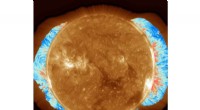
* Helium is the second most abundant element in the Sun, after hydrogen.
* The existence of helium in the Sun was crucial to understanding the Sun's energy production through nuclear fusion. This process converts hydrogen to helium, releasing tremendous amounts of energy.
In summary, the existence of helium in the Sun was confirmed through a combination of observing a unique spectral line and theoretically identifying it as a new element, later confirmed by its isolation and spectral analysis on Earth. This discovery revolutionized our understanding of the Sun's composition and energy production mechanisms.