1. Seeing through cosmic dust and gas:
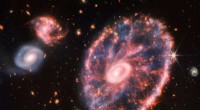
* Infrared light has longer wavelengths than visible light, allowing it to penetrate through clouds of dust and gas that obscure visible light.
* This is crucial for studying the early universe, where star formation and galaxy evolution were shrouded in dense gas and dust.
2. Observing cooler objects:
* Objects that emit less heat, like distant galaxies, cool stars, and planets, radiate primarily in the infrared spectrum.
* The JWST's infrared instruments allow us to study these objects in detail, providing valuable information about their composition, temperature, and evolution.
3. Redshift:
* The expansion of the universe causes the light from distant objects to be stretched, shifting it towards longer wavelengths.
* This redshift phenomenon pushes visible light from early galaxies into the infrared spectrum.
* The JWST can therefore observe these distant objects in detail, allowing us to study the very early universe.
4. Studying planetary atmospheres:
* Infrared light can penetrate planetary atmospheres and reveal their composition, temperature, and even the presence of water vapor and organic molecules.
* This information is crucial for understanding the formation and evolution of planets, and for searching for potentially habitable worlds.
5. Observing the formation of stars and planets:
* The JWST can observe the birthplaces of stars and planets, called "stellar nurseries", in detail.
* Infrared light allows us to see through the thick clouds of gas and dust where stars are forming, and to study the early stages of planet formation.
In summary, the JWST's infrared capabilities provide a unique window into the universe, allowing us to study objects that are hidden from visible light telescopes and to investigate a wide range of astronomical phenomena in unprecedented detail.