1. Gravity and Shape:
* Stronger Gravity: The more massive a planet is, the stronger its gravitational pull. This force attracts everything towards the planet's center.
* Spherical Shape: Gravity pulls matter evenly in all directions, resulting in planets becoming nearly spherical. Larger planets, with more mass, have more gravity and are therefore more spherical.
2. Planetary Formation:
* Accretion: During planet formation, smaller particles (dust, gas) collide and stick together due to gravity. The more massive a planet gets, the more gravitational force it exerts, attracting more material and growing larger.
* Clearing the Neighborhood: The gravitational pull of massive planets can clear their orbital paths of smaller objects, preventing the formation of additional planets or leaving only a few moons behind.
3. Orbital Properties:
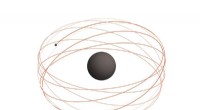
* Orbital Period: The more massive a planet is, the stronger its gravitational pull on its star. This leads to a shorter orbital period, meaning it takes less time to complete a full orbit around its star.
* Stability: Mass influences the stability of orbits within a planetary system. Massive planets can gravitationally "perturb" the orbits of smaller objects, potentially causing them to be ejected from the system.
4. Internal Structure and Activity:
* Heat and Pressure: A planet's mass creates enormous pressure and internal heat due to gravity. This heat can lead to volcanic activity, plate tectonics, and even magnetic fields.
* Atmospheric Retention: The gravitational pull of a massive planet can hold onto a larger and thicker atmosphere. This is why gas giants like Jupiter and Saturn have extensive atmospheres, while smaller rocky planets like Mars have much thinner atmospheres.
5. Life:
* Habitable Zone: A planet's mass influences its temperature and climate. For a planet to be habitable, its mass needs to be within a certain range that allows for liquid water to exist on its surface.
* Internal Activity: Geologic activity, driven by a planet's internal heat, can be essential for the evolution and sustainability of life. A planet with the right mass can have the right level of internal activity to support life.
In Summary:
Mass is a fundamental property that governs numerous aspects of a planet's existence, from its shape and formation to its orbital properties and internal activity. It plays a crucial role in determining whether a planet can support life or not.