1. Start as a Main Sequence Star:
* White dwarfs begin their lives as stars similar to our Sun, classified as main sequence stars.
* These stars fuse hydrogen into helium in their cores, producing energy and light.
2. Red Giant Phase:
* When a main sequence star exhausts its hydrogen fuel, it begins to swell into a red giant.
* The star's core contracts, becoming hotter, while the outer layers expand and cool. This creates a red giant appearance.
3. Planetary Nebula:
* As the red giant core continues to heat up, it eventually reaches a temperature where it can fuse helium into carbon and oxygen.
* This process causes the star to lose its outer layers, creating a spectacular planetary nebula.
4. White Dwarf Formation:
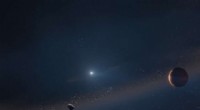
* The remaining core, now primarily composed of carbon and oxygen, is incredibly dense and hot. This is the white dwarf.
* White dwarfs are about the size of Earth but have a mass comparable to our Sun.
5. Cooling and Fading:
* White dwarfs have no internal source of energy and slowly cool over billions of years.
* As they cool, they become less luminous and eventually fade into black dwarfs, which are theoretical objects that are not yet observed.
Key Features of White Dwarfs:
* Dense: They are incredibly dense, with a teaspoonful of white dwarf material weighing tons.
* Stable: White dwarfs are supported by electron degeneracy pressure, which prevents them from collapsing further under their own gravity.
* Faint: They are faint, emitting little light compared to their progenitor stars.
* Hot: White dwarfs are extremely hot when they first form, with surface temperatures of tens of thousands of degrees Celsius.
Notable Types:
* Carbon-oxygen white dwarfs: The most common type, composed primarily of carbon and oxygen.
* Helium white dwarfs: Formed from stars that were too small to fuse helium into heavier elements.
Final Note: The transition from red giant to white dwarf is a relatively short stage in the life of a star, lasting only a few thousand years. This is in contrast to the billions of years a star spends on the main sequence.