1. No Atmospheric Distortion:
* Earth's atmosphere acts like a constantly moving, turbulent lens, bending and scattering light from celestial objects. This blurring effect is called "atmospheric seeing" and degrades the sharpness of images.
* Space telescopes are above the atmosphere, eliminating this distortion and allowing for much sharper images.
2. Access to All Wavelengths of Light:
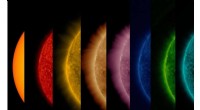
* Earth's atmosphere absorbs certain wavelengths of light, particularly in the infrared and ultraviolet ranges.
* Space telescopes can observe these wavelengths without atmospheric interference, allowing astronomers to study a wider range of celestial objects and phenomena.
3. Darker Skies:
* City lights, air pollution, and even moonlight create light pollution that interferes with astronomical observations.
* Space telescopes are located in the darkness of space, free from this light pollution, allowing for fainter objects to be detected and studied.
4. Stable Environment:
* Earth-based telescopes are constantly affected by vibrations from the ground and wind, leading to image blur.
* Space telescopes are in a stable environment, with no wind or ground vibrations to disrupt their observations. This allows for longer exposures and even sharper images.
5. Adaptive Optics:
* While space telescopes have the advantage of being above the atmosphere, Earth-based telescopes can employ adaptive optics technology to compensate for atmospheric distortion.
* Adaptive optics systems use deformable mirrors to counteract the blurring effects of the atmosphere, achieving sharper images. However, adaptive optics systems are complex and expensive, limiting their widespread use.
Overall:
The combination of these factors makes space telescopes superior to Earth-based telescopes for producing the sharpest and most detailed images of celestial objects. This is why space telescopes like Hubble have revolutionized our understanding of the universe.