Gravitational force is directly proportional to the product of the masses of the two objects, and inversely proportional to the square of the distance between them. In other words, the more massive an object is, the greater its gravitational force. Additionally, the closer two objects are to each other, the stronger the gravitational force between them.
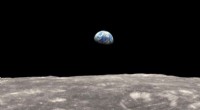
In the case of the Earth and the Moon, the Earth is much more massive than the Moon, so the Earth's gravitational force on the Moon is much stronger than the Moon's gravitational force on the Earth. This difference in gravitational force is what causes the Moon to orbit around the Earth.
The Moon's orbit around the Earth is not a perfect circle. Instead, it is an elliptical orbit, which means that the Moon's distance from the Earth varies throughout its orbit. When the Moon is closest to the Earth, it is said to be at perigee. When the Moon is furthest from the Earth, it is said to be at apogee.
The force of gravity between the Earth and the Moon also causes the tides. The tides are the rise and fall of the Earth's oceans. They are caused by the difference in the gravitational force of the Earth and the Moon on different parts of the Earth.