1. Doppler shift: The Doppler effect is the change in frequency of a wave in relation to an observer who is moving relative to the wave source. When the observer is moving towards the source, the waves appear to have a higher frequency, while when the observer is moving away from the source, the waves appear to have a lower frequency.
This effect can be used to measure the speed of rotation of the sun. Astronomers observe the sun at different points on its surface and measure the Doppler shift of the sunlight. This allows them to determine how fast the sun is rotating at different latitudes.
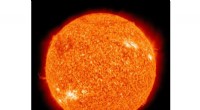
2. Sunspot tracking: Sunspots are dark patches on the sun's surface caused by strong magnetic fields. These magnetic fields can disrupt the convection process, which is the way that heat is transported from the sun's interior to its surface. This causes sunspots to be cooler than the surrounding areas.
Astronomers have tracked the movement of sunspots across the sun's surface and found that they move from east to west. This indicates that the sun is rotating from west to east.
3. Helioseismology: Helioseismology is the study of the sun's interior by measuring the vibrations of the sun. These vibrations are caused by the sun's rotation and can be used to determine the rotation rate at different depths within the sun.
By combining these different techniques, astronomers have determined that the sun rotates once every 27 days at its equator and once every 36 days at its poles.