1. Gravitational Interactions: The primary effect is the gravitational interactions between the two galaxies' stars, gas, and dark matter. As the galaxies approach, their gravitational pull on each other increases, causing their individual structures to be distorted and stretched.
2. Star Formation: The collision can trigger star formation due to the compression of gas and dust as galaxies interact. Large numbers of new stars may form in regions where the gas is densest.
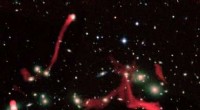
3. Tidal Disruptions: The strong gravitational forces can cause tidal disruptions in the galaxies' structures, leading to the elongation of both galaxies along the collision axis. This process is known as the "tidal tails" formation.
4. Merger and Relaxation: As the galaxies pass through each other, they experience complex gravitational interactions that gradually merge them into a single, larger galaxy. The process of merging can be chaotic, with the stars in both galaxies redistributed into new patterns and orbits.
5. Galactic Remnants: The end result of the merger depends on the masses of the two galaxies and their orbital parameters. The outcome can be:
- A massive elliptical galaxy if the collision is head-on and both galaxies have similar masses.
- A spiral galaxy if one of the galaxies is much larger than the other and the collision is not head-on.
- An irregular galaxy if the merging process is highly chaotic and there is no clear dominant galaxy.
6. Active Galactic Nuclei (AGN): The collision can lead to the formation of an AGN, where a massive black hole at the center of one or both galaxies becomes extremely active and emits large amounts of radiation.
7. Dark Matter Distribution: The merger affects the distribution of dark matter, which plays a crucial role in the dynamics and structure of galaxies. The combined dark matter halo of the merged galaxy may be more massive and extended compared to the individual galaxies before collision.
8. Supernovae and Outflows: The disturbed conditions during the merger can trigger a burst of supernovae, releasing heavy elements into the interstellar medium. Additionally, the merger can drive outflows of gas and dust from the central regions of the merged galaxy.
The evolution and the final outcome of the collision depend on various factors, such as the initial properties of the galaxies involved, the angles of the collision, and the dynamics of the interaction. However, galaxy mergers are essential processes that contribute to the formation and evolution of galaxies as observed in the universe today.