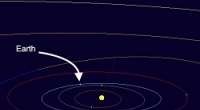
1. Orbital Motion: The Sun's gravity is the primary force that keeps planets in orbit around it. Each planet follows an elliptical path around the Sun, with the Sun located at one of the foci of the ellipse. The closer a planet is to the Sun, the stronger the gravitational pull and the faster it orbits.
2. Kepler's Laws of Planetary Motion: The motion of planets around the Sun is described by Johannes Kepler's three laws of planetary motion. These laws, derived from observations and mathematical analysis, explain the relationships between the planets' orbital periods, distances from the Sun, and their elliptical paths.
3. Tides: The Sun's gravity, along with the Moon's gravity, causes tides on Earth. The gravitational pull of the Sun creates a slight bulge on Earth's surface that faces the Sun. As Earth rotates, different parts of the planet move through these bulges, resulting in high and low tides.
4. Planetary Phenomena: The Sun's gravity influences various planetary phenomena. For instance, the Earth's axial tilt and the resulting seasons are caused by the combined effects of the Sun's gravity and Earth's rotation. The Sun's gravity also drives the formation of planetary atmospheres, as it determines the escape velocity needed for gases to escape from a planet's gravitational pull.
5. Planetary Formation and Evolution: The Sun's gravity played a crucial role in the formation of the solar system from a primordial cloud of gas and dust. The gravitational collapse and subsequent accretion of matter led to the formation of the Sun and the planets. Over time, the Sun's gravity continued to shape the evolution of the planets, including their internal structure, surface features, and interactions with neighboring celestial bodies.
6. Gravitational Interactions and Stability: The Sun's gravity maintains a delicate balance between the gravitational forces acting on different planets and other celestial bodies in the solar system. This gravitational equilibrium ensures that the planets remain in relatively stable orbits and do not collide with each other.
In summary, the Sun's gravity governs the orbital motions of planets, influences planetary phenomena like tides and seasons, and has played a fundamental role in shaping the formation and evolution of the solar system.