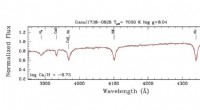
1. Spectral Type: The Sun emits its light at various wavelengths, and the analysis of its spectrum shows that the most prominent feature is the absorption lines of hydrogen, giving it the "G" spectral type.
2. Surface Temperature: The Sun has an effective surface temperature of approximately 5,778 Kelvin (or 5,505 degrees Celsius). This temperature is what gives it the characteristic yellow appearance.
3. Size: Compared to other stars, the Sun is considered to be relatively small to medium in size. Its diameter is around 1.4 million kilometers, which is approximately 109 times that of Earth.
4. Mass: The Sun is the most massive object in our solar system, accounting for about 99.8% of the total mass. Its mass is roughly 330,000 times that of Earth.
5. Luminosity: The Sun's luminosity, which represents the total amount of energy it emits per second, is immense. It is approximately 3.828 × 10^26 watts, which means it releases an enormous amount of energy in the form of light, heat, and other radiation.
6. Main-Sequence Phase: Stars spend a significant portion of their lives in the main-sequence phase, during which they fuse hydrogen into helium in their cores. The Sun is currently in this phase and will remain so for several billion more years.
7. Age: The Sun is estimated to be about 4.6 billion years old. Scientists determine the age of stars by measuring their chemical composition, rotation rates, and other factors.
8. Stability: The Sun is considered to be a relatively stable star, maintaining a relatively constant temperature and luminosity over long periods. This stability is essential for life on Earth to thrive.
Overall, the Sun's classification as a G-type main-sequence star helps astronomers understand its physical properties, its place within the universe, and its role in supporting the solar system and life on Earth.